
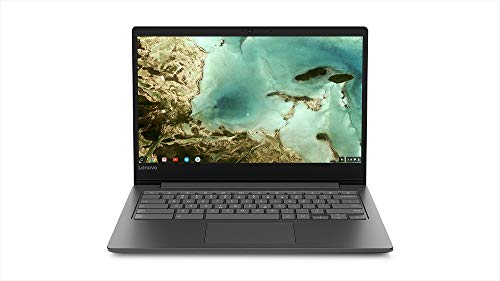
The Lenovo Chromebook S330 is a deliberately focused 14-inch Chromebook. Its specification points towards essential web-based computing, supported by Google Chrome OS, a MediaTek MT8173C processor and integrated IMG PowerVR GX6250 graphics. This is not a machine defined by expansive hardware; it is defined by a clear set of practical priorities.
A practical screen and chassis
The 14-inch display has a 1920x1080 resolution, giving the S330 a useful Full HD canvas for documents, browser windows and other Chrome OS work. The panel uses TN technology, however, which is a confirmed technical trade-off in the display specification. The casing uses PC + ABS on both the top and bottom, while the 1.45kg weight gives the laptop a portable, though not ultra-lightweight, profile.
The stated 10-hour battery life is one of the machine’s clearest strengths on paper. Combined with a 45Wh battery, it should support extended working away from a socket under the conditions represented by that rating. The figure is a manufacturer specification rather than an independent endurance result, but it gives the S330 a defined mobility proposition.
Connectivity takes centre stage
Lenovo has equipped the S330 with a useful spread of physical connections: USB 3.1 Gen 1, USB-C 3.1 Gen 2, HDMI 1.4, a card reader and a 3.5mm headphone/microphone combo jack. That selection should accommodate common external displays, accessories, removable cards and wired audio without relying entirely on adapters. Wireless connectivity is covered by 802.11ac 2x2 Wi-Fi and Bluetooth 4.1 through the Marvell 88W8897 solution.
This connectivity breadth gives the Chromebook a practical character. It is designed to slot into a range of desk and travel arrangements, with HDMI and card access alongside both USB formats. The specification also makes clear that this is a conventional, function-led laptop rather than a minimal port design.
Hardware boundaries
The 4GB memory allocation and MediaTek MT8173C processor establish a restrained platform. The S330 should therefore be considered for focused Chrome OS tasks rather than treated as a broadly specified computer. Storage is similarly modest: the machine is listed with either 32GB or 64GB of eMMC 5.1 storage. Those capacities and the eMMC format are central limitations of the configuration, particularly for buyers planning to keep substantial local files.
The verdict is consequently specific. The S330 makes the most sense for buyers seeking a Full HD 14-inch Chromebook with strong physical connectivity, Chrome OS and a 10-hour rated battery life. Its TN panel, modest memory, limited eMMC storage and 1.45kg weight make the trade-offs equally clear. As a focused, accessibly specified Chromebook, it has a coherent purpose; buyers wanting broader hardware headroom should look beyond this configuration.