
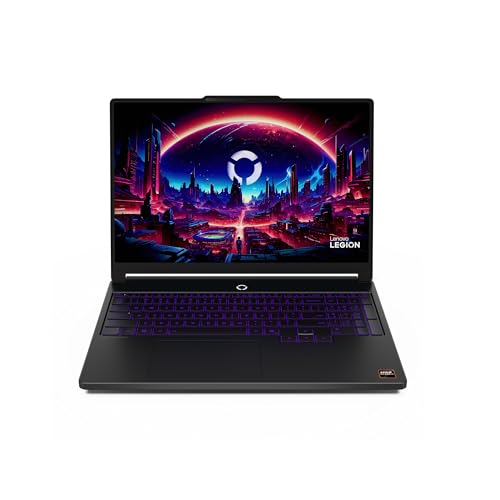
The Lenovo Legion 5a Gen 11 presents a clear performance-laptop proposition: a high-refresh OLED screen, dedicated RTX graphics and a generous memory allocation, wrapped in a chassis that remains portable enough to move between locations. Its specification is ambitious without being narrowly focused, giving it a credible role for gaming-oriented buyers as well as users who want substantial desktop-style capability from a laptop.
A performance-led core
The display is one of the machine’s strongest technical anchors. Its 15.3-inch OLED panel runs at 2560x1600 and 165Hz, combining a detailed WQXGA resolution with a refresh rate designed for fluid motion. That makes the screen particularly well matched to the laptop’s performance positioning, although the supplied figures establish the panel’s technical foundations rather than guaranteeing any particular real-world image result.
The processing hardware is similarly purposeful. AMD’s Ryzen 7 250 is paired with an NVIDIA GeForce RTX 5060 carrying 8GB of GDDR7 graphics memory. That dedicated GPU configuration is designed for demanding visual workloads, while 32GB of system RAM gives the laptop substantial headroom for multitasking. A 1TB NVMe SSD completes a storage arrangement that should accommodate a sizeable working library without relying solely on external drives.
Flexible by design
Connectivity is unusually well catered for. Two USB-A ports, including an Always On connection, sit alongside two USB-C ports supporting USB4 at up to 40Gbps, USB Power Delivery from 65W to 100W and DisplayPort 1.4. HDMI 2.1, Ethernet, a combined headphone and microphone jack, and a Slim Tip connection broaden the machine’s usefulness at a desk. Wi-Fi 7 and Bluetooth 5.4 provide current wireless standards on paper, while Windows 11 Home 64 supplies the operating-system platform.
The 80Wh battery and quoted 10.2-hour battery-life figure indicate that the design is intended to support more than short periods away from a socket. That figure remains a manufacturer specification rather than an independent test result, but it gives the laptop a defined endurance target. The 1.87kg weight is also notable for a system with this level of hardware, though it still represents a tangible carrying consideration alongside the 15.3-inch screen.
Practical compromises
The construction uses aluminium for the top and PC-ABS for the bottom. This is a mixed material design rather than an all-aluminium chassis, so buyers prioritising a consistently premium material specification may find the lower section a compromise. The larger display format adds useful working area, but also creates more physical bulk than a smaller laptop.