
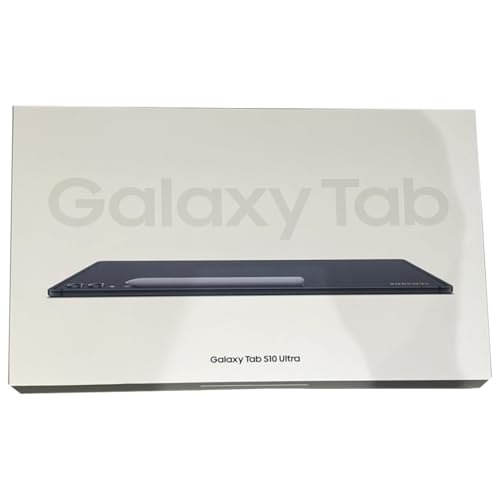
Opening assessment
The Samsung Galaxy Tab S10 Ultra makes its proposition immediately clear through scale. A 14.6-inch Dynamic AMOLED 2X display, WQXGA+ resolution of 2960 x 1848 and 120Hz refresh rate give this Android tablet a substantial visual platform for documents, creative work and media. Those figures establish the technical foundations for a spacious, high-refresh presentation, without requiring the device to be treated as anything smaller or more portable than it is.
That scale is paired with an octa-core processor specified at 3.4GHz, 2.8GHz and 2GHz, alongside 12GB of RAM. On paper, this is a substantial core specification for a tablet intended to handle demanding forms of multitasking and stylus-led work. The 256GB storage allocation provides a defined amount of local space, though buyers planning to keep extensive files or media on the tablet should account for that ceiling.
Designed around accessories
The tablet’s most distinctive productivity argument is its support for a stylus with gesture and remote-control functions. That makes pen-based interaction part of the product’s intended identity, rather than an incidental add-on. Keyboard support is also confirmed through the Book Cover Keyboard Slim, although that keyboard is sold separately. The accessory route therefore broadens the device’s working format, while the tablet itself remains the core purchase.
Wireless connectivity is comprehensively specified: Wi-Fi includes 2.4GHz, 5GHz and 6GHz bands, with 802.11be, EHT320, MIMO and 4096-QAM listed, while Bluetooth 5.3 is supported. The port specification is more narrowly defined, with a single USB Type-C connection at USB 3.2 Gen 1. That is a confirmed interface limitation for buyers whose workflows depend on the stated port standard.
The physical trade-off
The 11,200mAh battery capacity is a significant part of the hardware specification and suits the tablet’s large display on paper. It should appeal to buyers who prioritise capacity alongside screen area, though no endurance conclusion follows from capacity alone. The enhanced Armor Aluminum frame supplies the stated build material, while the 718g weight confirms that portability has been traded for this device’s expansive format.
The rear camera system combines 13MP and 8MP cameras, while the front uses dual 12MP cameras. These specifications provide clearly defined camera hardware, but they do not by themselves establish image quality or video performance.