
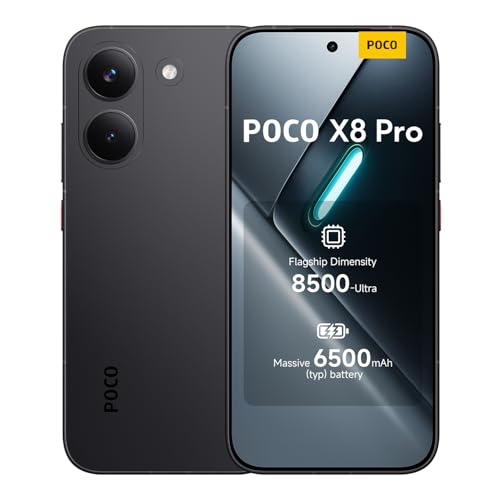
The Xiaomi POCO X8 Pro Max is built around a clear proposition: a large display, substantial battery and ambitious internal hardware, with fast charging intended to keep that capacity practical. On paper, it is a performance-focused smartphone for buyers who want strong headline specifications rather than a compact form factor.
Hardware with a clear purpose
The 8,500mAh battery is the defining figure. That is a substantial capacity for a smartphone and gives the device a strong endurance-oriented foundation, although the specification alone cannot establish actual runtime. The 100W charging system is a useful counterpart, with the supplied figure stating 50 per cent in 24 minutes. Together, those numbers suggest a design intended to combine considerable capacity with relatively rapid replenishment.
The processing platform is similarly assertive. Xiaomi specifies the Dimensity 9500s chipset, a CPU maximum frequency of 3.73GHz, 12GB of RAM and an Immortalist-G925 GPU. Those components establish ambitious core hardware on paper, though they do not by themselves prove application, gaming or thermal results. The 256GB storage allocation gives the phone a defined capacity for locally stored content, but buyers with extensive libraries will need to consider that fixed figure carefully.
A sizeable visual canvas
The 6.83-inch display makes the X8 Pro Max unmistakably a large-screen device. Its 2772×1280 resolution, 120Hz refresh rate and 3,500-nit peak brightness specification provide strong technical foundations for detailed presentation, fluid motion and considerable brightness headroom. Those are meaningful advantages for buyers who prioritise screen scale and display hardware, while the physical size remains an explicit trade-off for anyone seeking easier compact handling.
The camera arrangement is more restrained in its published numbers. A 50MP main camera with OIS is joined by an 8MP ultrawide camera, giving the phone two stated perspectives and optical stabilisation on the main unit. The large difference in resolution between those cameras is a confirmed specification trade-off: the system is not evenly matched across its listed lenses.
Who it suits
This is a sensible fit for buyers who place battery capacity, charging speed, display scale and processing hardware at the top of their priorities. The Black, White and Blue colour options add straightforward choice without changing that central identity. The phone is less naturally suited to shoppers whose priorities begin with a smaller body, expansive local storage or closely matched camera resolutions.